At <Quantum|Chamitas>, we believe science is learned best when there is room to ask questions and share ideas. That is why every new bridge with other science outreach projects is also an opportunity to broaden our students’ horizons and show them that STEM is not a single path, but a map full of possible connections.
On this occasion, we are happy to announce a collaboration with Making STEM Girly, a project created by Edith Nieves to bring science, engineering, and technology closer to children and young people in Venezuela, with a special focus on aeronautical engineering, physics, and space exploration.
The collaboration began with a simple conversation, where one of the questions was: How can we create educational resources that make complex topics understandable, interesting, and relatable for young students?
At <Quantum|Chamitas>, we work to introduce quantum computing to Venezuelan girls and teenagers through educational talks that are accessible, rigorous, and age-appropriate. Our goal is not to simplify science to the point of stripping it of depth, but to build pathways that enable students to approach concepts such as quantum computing, entanglement, superposition, and algorithmic applications through clear examples and meaningful experiences.
Making STEM Girly shares a vision very similar to ours. Through outreach content and activities, Edith seeks to spark curiosity about fields such as aeronautical engineering and space, showing that these disciplines can also be part of the imagination and professional future of Venezuelan girls.
During our meetings, we discussed the pilot talk for <Quantum|Chamitas> and how to adapt it for different groups: teenagers ready to engage with abstract ideas in greater depth, and younger children who need a more visual, hands-on, and playful entry point.
That exchange opened up a very valuable possibility: creating specialized educational materials that connect two fascinating scientific worlds. On one hand, quantum computing invites us to think about new ways of processing information. On the other hand, aerospace engineering allows us to look toward the sky, airplanes, rockets, space missions, and the technologies that make it possible to explore beyond Earth.

Although these fields may seem far apart, they have something in common: they spark profound questions. How does nature work at very small scales? How do we design systems capable of flight? What kind of technology do we need to explore space? What scientific tools can help us solve problems we still do not fully know how to address?
These questions are an excellent gateway into STEM education. They make it possible to work on logical thinking, creativity, problem-solving, science communication, and the confidence needed to learn topics that are often presented as inaccessible.
The collaboration between <Quantum|Chamitas> and Making STEM Girly aims precisely at that: designing educational experiences that combine rigor with approachability. We want to create resources that do not treat girls and young people as passive spectators of science but as active participants capable of discussing ideas and recognizing themselves in scientific and technological spaces.
We also want to highlight Edith’s work, as she develops Making STEM Girly into a project with great potential for science outreach in Venezuela. Her focus on aeronautical engineering and STEM education brings an important perspective: showing that science can also be told through technical imagination, design, movement, flight, and exploration.
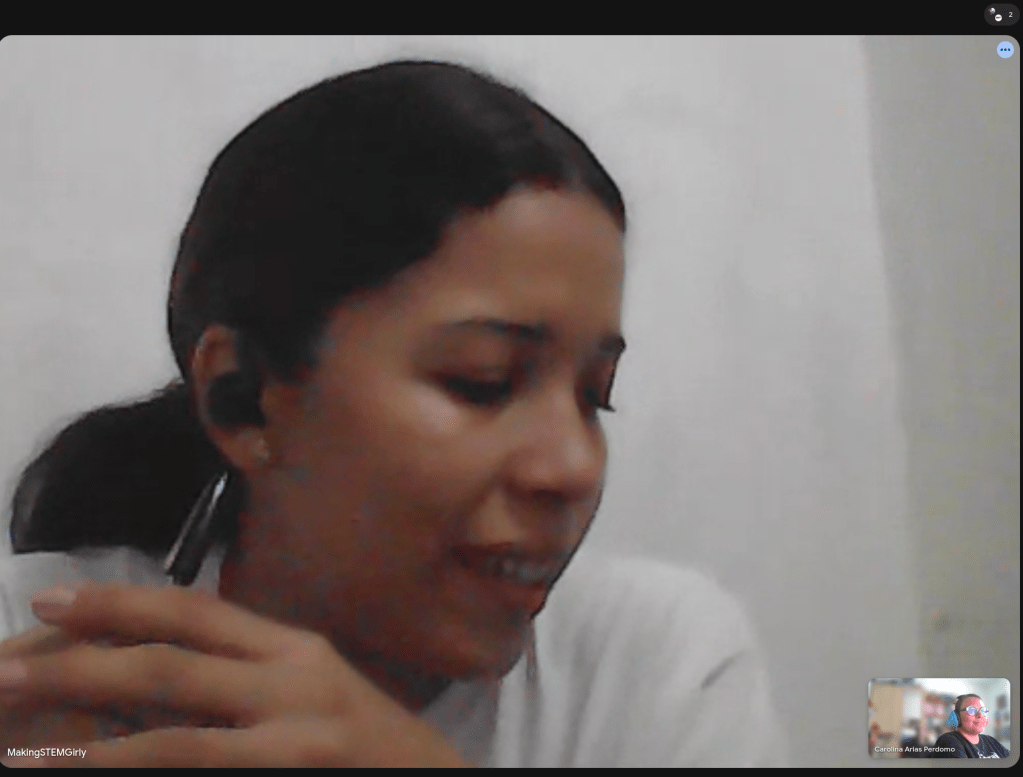
For <Quantum|Chamitas>, this collaboration represents an important step in creating a network of educational projects that share the same conviction: Venezuelan girls deserve early, serious, and inspiring access to contemporary science.
In the next steps, we will work on adapting content, designing activities, and exploring workshop formats that can serve different age groups. The goal is for every resource to have a clear pedagogical purpose while also carrying a spark of wonder.
Because learning quantum computing does not have to feel distant. And learning aerospace engineering does not have to seem impossible. When these topics are taught with care, context, and creativity, they can become a powerful invitation to imagine scientific futures from Venezuela, grounded in knowledge, collaboration, and purpose.


Leave a Reply